
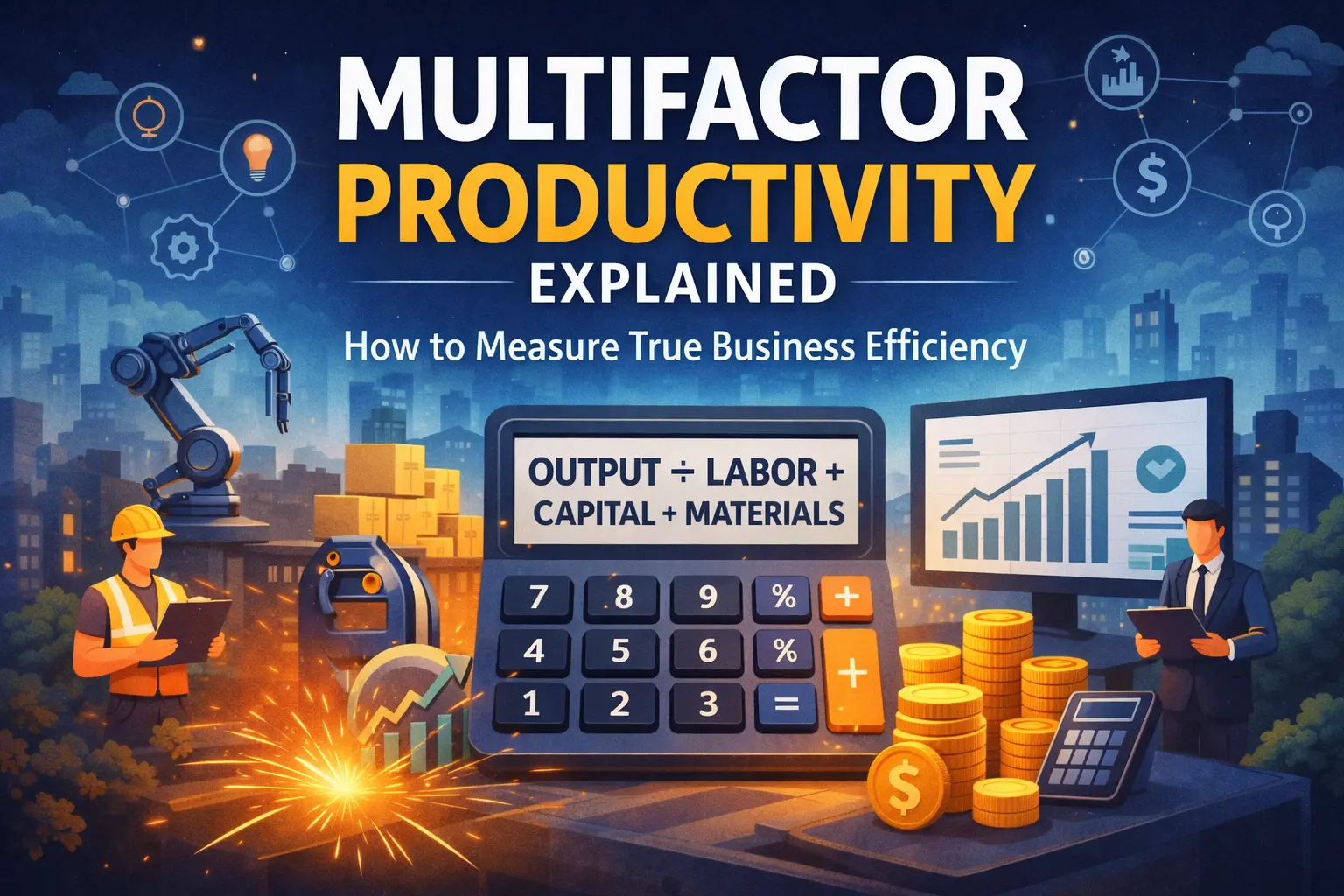
Most businesses measure productivity incorrectly.
They track labor output and assume they understand performance. But in modern business environments, labor is only one part of the efficiency equation.
Companies invest heavily in:
- Machinery
- Technology
- Software systems
- Infrastructure
- Capital
- Materials
If you measure labor productivity alone, you ignore the true cost structure behind output.
That’s where Multifactor Productivity (MFP) becomes essential.
This guide will explain:
- What multifactor productivity is
- How it differs from labor productivity
- The multifactor productivity formula
- Step-by-step calculation examples
- Real-world industry applications
- Strategic use in business planning
- Common calculation mistakes
- How to improve multifactor productivity
By the end, you’ll understand how to measure true business efficiency – not just workforce performance.
1. What Is Multifactor Productivity?
Multifactor productivity measures output relative to multiple combined inputs – not just labor.
Unlike labor productivity, which focuses only on hours worked, MFP evaluates:
- Labor
- Capital
- Equipment
- Technology
- Materials
- Energy
In simple terms:
It answers this question:
How efficiently is the entire business system converting total inputs into output?
2. Multifactor Productivity Formula
The general formula is:
Multifactor Productivity = Total Output ÷ Combined Inputs
Where:
Combined Inputs = Labor Cost + Capital Cost + Material Cost + Other Inputs
3. Basic Calculation Example
Let’s break this down clearly.
Example:
Annual Output: ₹10,000,000
Inputs:
Labor cost: ₹4,000,000
Equipment depreciation: ₹1,500,000
Material cost: ₹2,000,000
Energy cost: ₹500,000
Total Inputs:
₹8,000,000
MFP:
10,000,000 ÷ 8,000,000 = 1.25
This means:
For every ₹1 invested, the company generates ₹1.25 in output.
That 0.25 represents efficiency gain.
4. Labor Productivity vs Multifactor Productivity
Many managers confuse the two.
| Labor Productivity | Multifactor Productivity |
|---|---|
| Measures output per labor hour | Measures output per total input |
| Focuses on workforce | Focuses on entire system |
| Operational metric | Strategic metric |
| Easier to calculate | More complex |
Example:
If automation reduces labor hours, labor productivity may rise dramatically.
But if automation requires expensive machinery, multifactor productivity may remain stable or even decrease.
This is why MFP gives a more realistic performance picture.
5. Why Multifactor Productivity Matters
Modern businesses rely heavily on capital and technology.
Without MFP measurement, you cannot:
- Evaluate automation ROI
- Assess capital investments
- Compare departments fairly
- Understand true profitability
- Make long-term strategic decisions
MFP aligns productivity measurement with financial performance.
6. Industry Examples
Manufacturing
High capital investment industry.
Automation increases labor productivity significantly.
But MFP reveals whether machinery cost justifies output growth.
IT & Software
Labor is primary input, but:
- Software licenses
- Infrastructure
- Cloud hosting
- Tools
All contribute to output.
MFP helps measure technology efficiency.
Healthcare
Hospitals invest in:
- Medical equipment
- Facilities
- Staffing
- Technology systems
Labor productivity alone ignores equipment utilization.
MFP reveals overall operational efficiency.
7. Example: Automation Investment Decision
Scenario:
Before automation:
Output: ₹5,000,000
Total inputs: ₹4,000,000
MFP = 1.25
After automation:
Output: ₹7,000,000
Total inputs: ₹6,000,000
MFP = 1.17
Even though output increased, efficiency dropped.
This signals over-investment.
MFP protects against misleading optimism.
8. Marginal Multifactor Productivity
Marginal analysis helps evaluate incremental investment.
Marginal MFP =
Change in Output ÷ Change in Inputs
If marginal output grows faster than marginal inputs, investment is justified.
9. Common Mistakes in MFP Calculation
- Ignoring depreciation
- Double counting costs
- Using inconsistent time periods
- Excluding energy or overhead
- Mixing revenue and physical units improperly
Consistency is critical.
10. How to Improve Multifactor Productivity
Improving MFP requires system-level thinking.
1. Optimize Capital Utilization
Underused equipment reduces MFP.
Improve:
- Scheduling
- Maintenance
- Asset allocation
2. Reduce Material Waste
Waste increases inputs without increasing output.
Implement:
- Lean manufacturing
- Inventory control
- Quality management
3. Technology Efficiency
Technology should increase output more than cost.
Measure:
- Software ROI
- Automation savings
- Workflow acceleration
4. Process Integration
Disconnected systems reduce productivity.
Integrate:
- ERP systems
- Production planning
- Financial reporting
11. Long-Term MFP Strategy
Sustainable MFP growth requires:
- Continuous measurement
- Data-driven investment
- Balanced labor-capital allocation
- Innovation
- Workforce training
Short-term labor productivity spikes mean little without MFP alignment.
12. Benchmarking Multifactor Productivity
MFP benchmarks vary by industry.
Instead of comparing externally:
Compare:
- Year-over-year performance
- Pre- and post-investment
- Departmental efficiency
Trend analysis matters more than static numbers.
13. Economic Perspective
At a national level, multifactor productivity drives GDP growth.
Countries with high MFP:
- Innovate faster
- Compete globally
- Improve living standards
Businesses with high MFP:
- Scale faster
- Maintain margins
- Survive competition
14. When to Use Labor Productivity Instead
Labor productivity is ideal when:
- Capital costs are stable
- Short-term operational measurement is needed
- Workforce performance analysis is primary goal
MFP is ideal when:
- Investment decisions are involved
- Automation is evaluated
- Strategic planning is required
15. Practical Weekly Framework
To track MFP:
Step 1: Define output clearly
Step 2: List all input categories
Step 3: Assign monetary value
Step 4: Apply formula
Step 5: Compare month-to-month
Step 6: Investigate major changes
This creates long-term efficiency clarity.
Final Thoughts
Multifactor productivity reveals the truth behind business performance.
Labor productivity alone may look impressive — but without considering capital and material costs, the picture is incomplete.
MFP measures:
System efficiency.
Investment effectiveness.
True operational performance.
If your business invests heavily in equipment, software, or infrastructure – you need multifactor productivity analysis.
Measure beyond labor.
Analyze total inputs.
Make strategic decisions based on real efficiency.