
Managing a team without measuring productivity is like driving without a dashboard. You may feel busy, but you don’t truly know if you’re moving efficiently.
If you’re a manager, business owner, or operations lead, you’ve likely asked:
- Are we getting enough output from our team?
- Where are we losing time?
- How can we increase performance without hiring more staff?
The answer starts with one powerful metric:
Labor productivity.
In this guide, you’ll learn:
- How to calculate team productivity correctly
- The exact formula managers should use
- Real business examples
- Common calculation mistakes
- Proven ways to improve team efficiency
You can also instantly measure your numbers using our Labor Productivity Calculator to avoid manual errors.
What Is Team Efficiency?
Team efficiency (or labor productivity) measures how much output your team produces per labor hour.
It answers this question:
How much work is being produced for every hour paid?
This metric works for:
- Manufacturing teams
- Technician crews
- Sales teams
- Healthcare staff
- Service companies
- Small businesses
The Team Productivity Formula
The standard formula managers use is:
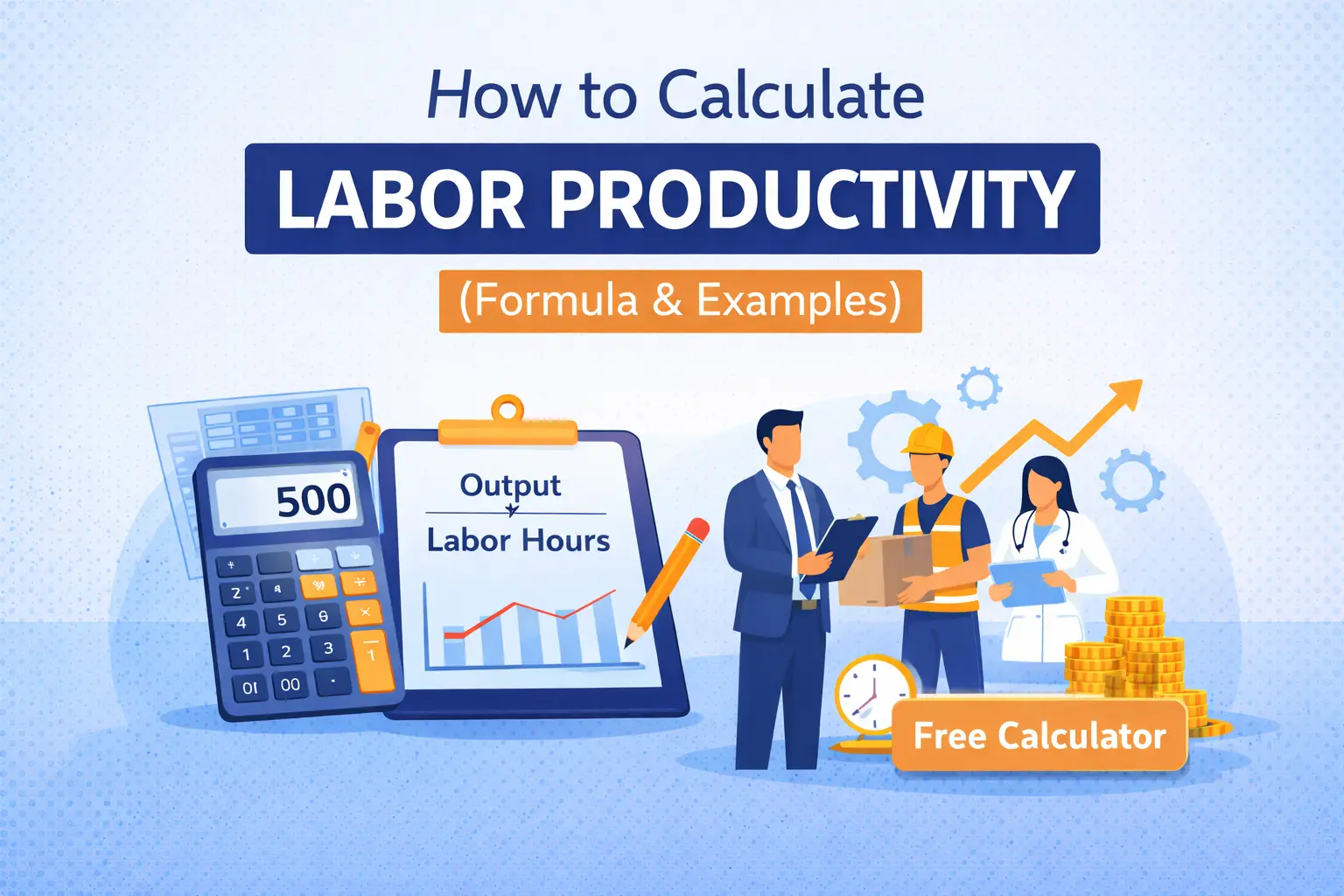
Labor Productivity = Total Output ÷ Total Labor Hours
Let’s break it down properly.
Step 1: Define Your Output
Output depends on your business type:
Manufacturing → Units produced
Technician services → Jobs completed
Healthcare → Billable sessions
Sales → Revenue generated
Welding shop → Welds completed
Important: Keep output consistent.
Step 2: Calculate Total Labor Hours
Total Labor Hours = Number of Employees × Hours Worked
Example:
8 employees working 8 hours each
= 64 total labor hours
Step 3: Apply the Formula
If your team produced 320 units in 64 labor hours:
320 ÷ 64 = 5 units per hour
Your team productivity is 5 units per labor hour.
You can automate this instantly using our free Labor Productivity Calculator.
Real-World Example: Manufacturing Team
A factory employs 12 workers.
Each works 7 hours per day.
Total labor hours = 12 × 7 = 84 hours
Daily output = 420 units
Labor productivity = 420 ÷ 84
= 5 units per hour
Now imagine you improve workflow and increase output to 504 units.
New productivity = 504 ÷ 84
= 6 units per hour
That’s a 20% improvement — without hiring anyone.
Real-World Example: Technician Service Business
A repair company has:
5 technicians
8-hour shift
Total labor hours = 40
Jobs completed = 50
Productivity = 50 ÷ 40
= 1.25 jobs per hour
If routing improves and they complete 60 jobs:
60 ÷ 40 = 1.5 jobs per hour
That’s a major efficiency jump.
Service businesses often use a Technician Productivity Calculator to monitor this more accurately.
Revenue-Based Productivity (For Managers)
Some managers prefer measuring revenue per labor hour.
Formula:
Revenue Productivity = Total Revenue ÷ Total Labor Hours
Example:
₹400,000 revenue
200 labor hours
= ₹2,000 per labor hour
This is extremely useful for:
- Consulting firms
- Clinics
- Sales teams
- Agencies
Common Mistakes Managers Make
1️⃣ Measuring Output Without Time
Tracking units without tracking labor hours gives incomplete data.
2️⃣ Ignoring Downtime
Idle time, machine breakdowns, meetings, and delays matter.
3️⃣ Comparing Different Departments Incorrectly
Manufacturing productivity cannot be compared with administrative productivity.
4️⃣ Not Measuring Consistently
Weekly tracking reveals patterns. Monthly only is too late.
5️⃣ Focusing Only on Quantity
Higher output with poor quality reduces long-term profit.
How to Boost Team Efficiency (Proven Strategies)
Once you know your numbers, improvement becomes easier.
Here’s how smart managers increase productivity:
1️⃣ Remove Bottlenecks
Identify where work slows down.
Common bottlenecks:
- Equipment delays
- Approval processes
- Supply chain gaps
2️⃣ Improve Scheduling
Avoid:
- Overstaffing
- Understaffing
- Poor shift planning
Better scheduling improves output instantly.
3️⃣ Invest in Training
Skilled workers:
- Make fewer mistakes
- Work faster
- Require less supervision
4️⃣ Introduce Automation
Automation improves labor productivity dramatically.
Examples:
- Workflow software
- Machine upgrades
- CRM systems
- Task management tools
For broader analysis, consider measuring Multifactor Productivity, which includes technology and capital alongside labor.
5️⃣ Set Measurable Benchmarks
Track:
- Units per hour
- Revenue per labor hour
- Jobs per technician
- Sessions per therapist
When employees see measurable goals, performance improves.
What Is a Good Team Productivity Rate?
There is no universal standard.
It depends on:
- Industry
- Skill level
- Technology
- Market conditions
Instead of chasing a “perfect number,” focus on:
- Improving your past performance
- Benchmarking within your industry
- Tracking trends over time
Weekly Productivity Review Framework for Managers
Use this simple 5-step system:
- Record total output
- Calculate total labor hours
- Apply the formula
- Compare with previous week
- Identify one improvement area
Repeat weekly.
Small improvements compound fast.
Team Productivity vs Employee Efficiency
Employee efficiency focuses on how well an individual performs.
Team productivity measures total output divided by total hours.
You need both.
If team productivity is low but individuals perform well, workflow issues may exist.
Frequently Asked Questions
Weekly is ideal. Monthly minimum.
Yes. Workflow, automation, and scheduling improvements often increase output.
For service industries, yes. For manufacturing, unit-based measurement is better.
Absolutely. Even 5-person teams benefit from tracking output per hour.
Final Thoughts
If you’re managing a team without measuring productivity, you’re guessing.
The formula is simple:
Total Output ÷ Total Labor Hours
But the impact is powerful.
Once you measure productivity consistently:
- You identify weak points
- You improve performance
- You increase profitability
- You make data-driven decisions
Start today.
Use our free Labor Productivity Calculator to calculate your team’s efficiency and discover where improvement is possible.
Better measurement creates better management.